




EXPLORE REAL ESTATE INSIGHTS FOR SMART MOVES AND INFORMED CHOICES
Your Guide to Trends, Market Tips, and Property Investment Advice
AI in Real Estate: Property search and investment decisions of the year 2026
Feb 26, 2026
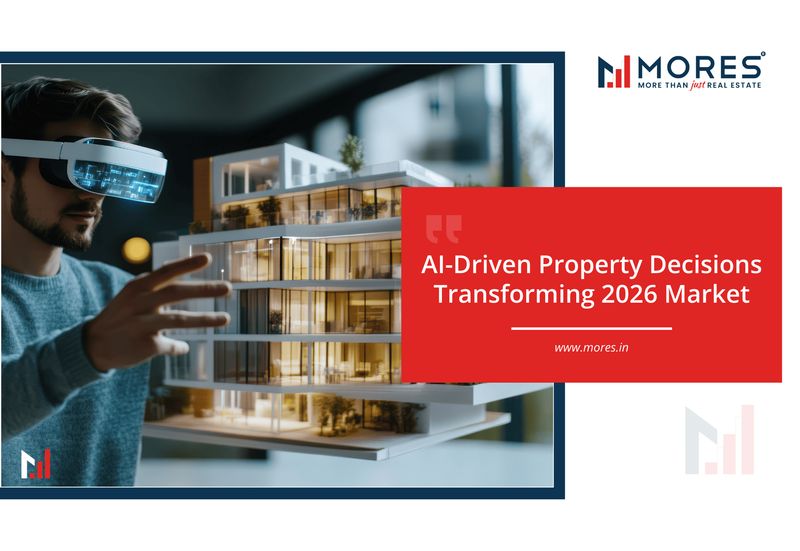
Real estate and AI tools can no longer be discussed as experimental technologies today because they have become integral to the modern property ecosystem. The future of the interaction among the buyer, investor, and developer in the real estate market is determined by AI-driven innovation as we head into 2026.
The real estate business, traditionally thought of as being traditional and relationship-based, is experiencing a swift digital transformation. The core of this change is the AI in real estate that is transforming the process of discovering, assessing, selling, and buying properties. In the transformations of property search, predictive analytics, virtual tours, and intelligent recommendations, transactions are increasingly becoming faster, smarter, and more informed with the influence of AI tools.
How Artificial Intelligence is Reshaping the Real Estate Sector
Artificial Intelligence has brought automation, predictive, and personalisation in the property transactions. The effect of AI in real estate is felt in all the phases of the property cycle, such as where investment opportunities are located and how to seal deals.
AI real estate trends in India 2026 reflect a major shift towards data-driven decision-making. As cities continue to grow and gain infrastructure, as well as go digital, AI is assisting in the management of complex market dynamics effectively. AI-driven insights have substituted intuition in the development, brokering, and purchasing of products. This revolution is altering the way properties are searched, sold, and priced.
The way AI optimises Property Search Resolutions
Conventionally, the process of searching for a property used to be tedious and time-consuming as it required visiting numerous sites and comparing prices manually. This is made easier today by AI, which is intelligent in filtering and behavioural learning. The AI aspect of smart property search is that it can interpret the user preferences, including:
- Budget range
- Preferred locations
- Lifestyle needs
- Commute patterns
- Investment goals
Using this information, AI platforms can provide AI home recommendations on a one-on-one basis, which is much more relevant and helps to get rid of search fatigue.
The Change of Price Discovery with AI Property Valuation Tools
One of the greatest problems in the field of real estate has always been the issue of proper pricing. AI property valuation technologies increased the analysis of large amounts of data, which now includes:
- Past transaction information.
- Trends of market demand and supply.
- Developments in infrastructure.
- Neighbourhood development indicators and indices.
- Rental yield patterns
These tools make it possible to analyse the real estate market with the help of AI and provide an accurate assessment of property values, and exclude guesses.
Artificial Intelligence Tools that predict the price of real estate
The rise of AI tools that give predictions on the price of real estate is one of the most potent developments. Through machine learning algorithms, AI analyses macroeconomic factors, infrastructural projects, and population changes to predict price gains. This feature aids in the way AI aids in real estate investment choices, enabling investors to:
- Determine high-growth micro-markets.
- Avoid overheated zones
- Predict long-term ROI
- Strategic market entry in time.
These predictive insights are transforming AI in the real estate investor world, with investment planning becoming a lot more scientific rather than speculative.
Artificial Intelligence of Virtual Property Tours: Reimagining Viewing Experiences
The evaluation of a property is no longer done physically by site visits. Virtual property tours AI integrates computer vision, augmented reality, and 3D mapping to provide immersive walkthroughs.
Buyers can now:
- Explore layouts remotely
- Design interiors with personalisation.
- Compare various properties in real time.
- Decision-making of shortlists via travel.
This new technology improves the AI influence on the experience of purchasing a house, particularly among the NRI customers, as well as the distant investors.
Real Estate Chatbot and AI: 24/7 support
The real estate chatbots and AI have also changed customer interaction. These smart assistants can deal with:
- Instant query resolution
- Property suggestions
- Appointment scheduling
- Documentation guidance
- Loan eligibility insights
This has enhanced the speed of response greatly, and the automation with AI in real estate leads allows developers to process the inquiries effectively.
The AI Property Search has the following advantages for the Home Buyer
The convenience is not the only advantage of AI property search to home buyers. AI will improve decision-making as it provides:
- Personalised Results:- AI knows the patterns of behaviours, so that the listings are not just the ordinary filters.
- Faster Shortlisting:- Automated comparisons and insights save weeks of research.
- Data-Driven Confidence:- Buyers make well-informed decisions with predictive analytics and valuation models.
- Less Information Overload:- AI filters out the unnecessary listings, rather than bombarding the users.
This is a clear indication of the role of AI tools in searching for property as an efficiency and precision tool.
Artificial Intelligence in Real Estate Investing: Portfolio Smarts
One of the largest beneficiaries of AI in real estate is investors. With AI, diversification of a portfolio is smarter because it analyses:
- Rental demand heatmaps
- Infrastructure Pipeline Data: Infrastructure data displays information about the infrastructure pipeline of the appropriate company.
- Employment growth clusters
- Migration patterns
- Yield performance trends
By using AI in analysing real estate markets, investors will be in a position to make purchases based on future economic corridors.
The Best AI investment tools in 2026 to invest in property
A number of AI tools under the best category to invest in property are becoming essential to the industry:
- Price forecasting predictive analytics.
- Artificial intelligence pricing engines.
- Remote assessment visualisation (virtually).
- Intelligent CRM systems of automated interaction.
- Investor market intelligence dashboards.
All these technologies are the changing face of real estate and AI-driven tools that are transforming the international property markets.
The place of Mores Techno in a Real Estate Ecosystem based on AI
Mores is modifying advisory services to data-driven decision-making in the changing environment of AI property transactions, which will guide buyers and investors to venture into sophisticated markets. Through a blend of market research, technology-supported knowledge, and strategic advisory, the company aids its clients in assessing undertakings, comprehending the developmental trends of locations, and arriving at knowledgeable choices in terms of investments. As AI advances in search of properties, valuation, and analysis, advisory services such as Mores are important in converting such digital provisions to real-world real-estate decision-making.
AI in Real Estate India: The Future
AI in real estate in India has a strong connection with the future of smart cities, digital infrastructure, and proptech. AI will be combined with:
- IoT-enabled smart homes
- Transaction based on blockchain.
- Compliance systems that are automated.
- Urban planning analytics
- Sustainable development modelling.
With the maturation of AI, AI will not just be felt in real estate only through transactions; it will also affect the way cities are planned.
Summary
The introduction of AI into the real estate industry can be seen as one of the biggest technological changes in the real estate industry. The influence of AI tools on the search for properties is changing the way individuals purchase, sell, and invest in properties, since smart suggestions, predictive pricing, and realistic virtual experiences are reshaping the process.
With the current developments in real estate and AI applications, the market is becoming more efficient, transparent, and user-friendly. The combination of AI property valuation, AI property virtual tours, or AI property market analysis is making technology provide buyers and investors with insights that were previously unavailable to them.
It is expected that AI will stop being a benefit and become a requirement in the next several years. To the stakeholders on both ends of the spectrum, the effects that AI will have on the industry dynamics in the real estate market will be vital to remaining competitive in this fast-changing environment.
Recent Blogs


Assistant


