

Delhi Master Plan 2047: Will It Impact NCR Real Estate?
Aug 18, 2026
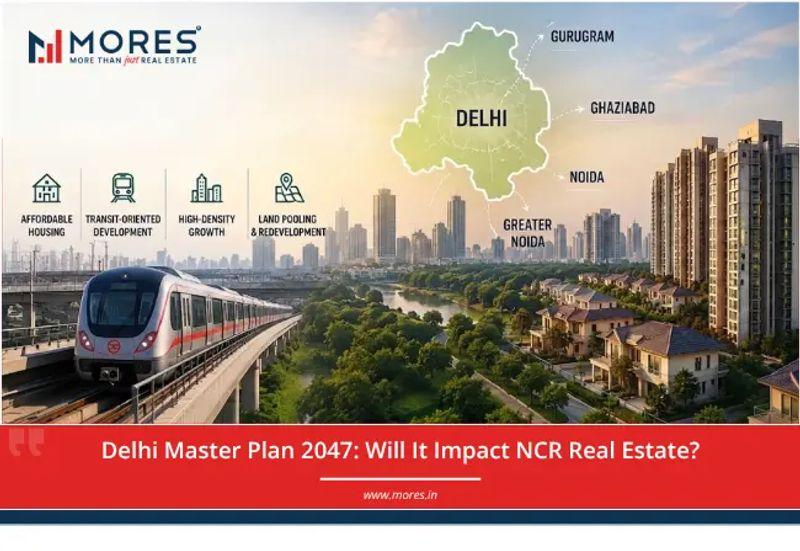
Yes, the Delhi Master Plan 2047 will certainly affect the real estate in Delhi NCR, but those changes will happen gradually once all the components of the plan, like housing, infrastructure, TOD, land pooling, and redevelopment policies, are put into action. On 12 August 2026, the plan was approved by the Delhi Development Authority (DDA) and will be forwarded to the Ministry of Housing and Urban Affairs for final approval and notification. For home buyers, investors, and real estate developers keeping track of real estate in Delhi NCR, the plan is crucial as housing supply, connectivity, and land use in Delhi can impact demand for properties in nearby real estate markets like Noida, Greater Noida, Ghaziabad, Gurugram, and Faridabad.
What is the Delhi Master Plan 2047?
The Delhi master plan 2047 is a long-term plan that aims to guide the city of Delhi on urban growth, land use, housing, infrastructure, environmental development, and transportation development. It has been designed to offer a wider planning context for the capital as it expands in the number of its residents and its economic activity.
The plan emphasizes housing availability, the incentives for planned redevelopment, transit-oriented growth, and the better use of existing urban land. It also takes care of sensitive areas like the Yamuna floodplain and makes proposals that can facilitate more organised development.
This makes the plan significant for real estate in Delhi NCR, because Delhi's property market cannot be viewed separately from the wider NCR. Capital connectivity and housing supply changes can impact the selection of where buyers will reside and where developers may see future opportunities.
How Will It Impact NCR Real Estate?
The most significant potential impact may be through the housing and infrastructure aspects of the plan. Delhi has been facing high land values and restricted possibilities for traditional growth and expansion. This has the potential to alter the distribution of housing demand, as the supply of housing increases, both through redevelopment and through higher-density development via land pooling.
In Delhi real estate, it might translate to an increase in the number of homes available in certain areas. However, it may have two consequences for NCR markets. An expansion of the city of Delhi in terms of housing can attract demand from neighbouring cities, and this can be retained in the city, some argue. In the absence of affordable and adequate housing products, buyers may persist in their migration towards Noida, Greater Noida, Ghaziabad, and other cities in the NCR.
1. Affordable Housing Could Influence Buyer Demand
Low-cost housing is a crucial component of Delhi's plan for the future. There is a high demand for housing in the city in the next few decades, and smaller, more affordable homes are essential for meeting the demand.
The focus on housing supply in the plan may help to make more residential options available. This can be advantageous to first-time home buyers and middle-class people who are constrained by high prices in developed areas of the national capital.
But costs will continue to be an important consideration. As the newly developed homes in Delhi continue to be out of reach for many buyers, the demand may continue to shift towards the neighboring NCR cities.
2. Transit-Oriented Development Could Create New Property Hotspots
One of the key elements to monitor is Transit-Oriented Development, or TOD.
The Transit-Oriented draft policy for the city of Delhi that aims to facilitate development with greater density around key public transport corridors. The policy should promote development along Metro corridors and other mass-transit facilities.
This may drive up the property prices in Delhi NCR, near Metro stations and major transport hubs. Proximity to other well-connected areas is important for buyers and adds appeal for developers.
Improving transportation between Delhi and its neighboring cities will facilitate ease of living in other cities and commuting to Delhi for work.
3. High-Density Development Could Change Delhi's Property Market
Delhi is facing a shortage of land for development in relation to its housing needs. This is creating the need for more and more redevelopment and vertical growth.
A higher density of development can enable more homes and businesses to be built without needing to extend the building over a large area horizontally. It can also be applied to mixed-use neighbourhoods where housing is nestled with retail and services, and closer to transport infrastructure.
This may provide opportunities in Delhi real estate in areas that are appropriate for redevelopment. In the case of older residential developments, planning rules could make it economically viable to rebuild or renovate these areas over time, making them more appealing.
However, higher density needs to be accompanied by sufficient roads, parking, water supply, drainage, public transport, and social infrastructure. Increased construction density alone may not bring sustainable development without such facilities.
4. Land Pooling Could Unlock New Development Areas
The other significant aspect of the urbanisation plan is land pooling. The policy is designed to facilitate the amalgamation of private land for planned development to enable infrastructure (roads and public facilities) to be supplied on a coordinated basis. Implementation of the current land pooling regime has been an issue, such as securing adequate landowner participation.
This is crucial because policy can be announced, but this does not mean new houses are built. Whether the land pooling will become a significant source of supply in the future for residential developments will depend on actual implementation.
It could pave the way for group housing and commercial development and supporting infrastructure in parts of Delhi's outskirts if implemented properly.
Thus, land pooling zones should be paid attention to, but investment decisions should be made based on the verified progress of development, and not just on expectations.
5. Noida, Greater Noida and Ghaziabad Could See Spillover Effects
The effect of the master plan, Delhi 2047, will not be limited to the administrative area of the city of Delhi. NCR is an interdependent city region. Many people either work or reside in Delhi; however, they reside in other nearby cities due to the variation in property prices, house options, and availability of newer projects.
If Delhi's housing supply increases substantially, it could retain some buyers within the capital. Meanwhile, the enhanced connectivity may make NCR more appealing as access to Delhi would become easier.
Residential demand could be boosted with the support of Metro, expressways, and RRTS, which could benefit Noida, Greater Noida, and Ghaziabad the most.
The broader NCR Regional Plan 2041 also focuses on regional mobility, economic corridors, and affordable housing, reinforcing the importance of connectivity across the region.
6. Environmental Regulations Could Restrict Some Development
The Delhi Master Plan doesn't imply that all the parts of Delhi will be accessible for development.
Classified as the O-Zone, the floodplain of the river is environmentally sensitive, and there are restrictions on construction aimed at safeguarding the environment of the river and minimizing the risks of flooding.
This is especially relevant for prospective property buyers, as having a major infrastructure corridor nearby does not necessarily make the land developable. Before buying land, investors should check land-use classifications, approvals, environmental limitations, and development regulations.
This aspect of the plan could also influence Delhi real estate by directing future development away from environmentally sensitive locations and towards areas where planned urbanisation is permitted.
What Should Property Buyers Watch?
Latest real estate development in Delhi ought to be taken alongside real developments on the ground for viewers who are buying or investing in real estate.
Some of the major considerations are:
- Connectivity: Look at the Metro, RRTS, expressways, and major road access.
- Land use: Verify the property's approved land-use classification.
- Infrastructure: Check whether the proposed infrastructure is officially approved and progressing.
- Project approvals: Verify RERA registration and sanctioned plans where applicable.
- Development timelines: Do not rely only on long-term announcements.
- Affordability: Compare Delhi properties with Noida, Greater Noida, Ghaziabad, and Gurugram.
- Rental demand: Employment hubs and transport stations can support rental demand.
- Environmental restrictions: Check whether the property falls within a restricted or sensitive zone.
Reliable, latest real estate news on Delhi NCR developments can be useful to buyers to differentiate between what is actually taking place and what is just being said about a project's potential.
Will Property Prices Rise Because of the Master Plan?
The answer is not necessarily an immediate yes.
While the master plan can provide room for future development, the price of properties also relies on a number of aspects, such as supply and demand, infrastructure, employment, interest rates, construction costs, and buyer mood.
Better connectivity, redevelopment opportunities, and supporting infrastructure may drive higher demand in areas. But places where there's been a delay in implementation may not experience the same gains.
So, the chances are that there will be a gradual rise in property values in Delhi real estate, rather than a sudden explosion. One should consider following the updates about real estate news in Delhi NCR to have a better understanding of Delhi real estate.
Conclusion
The Delhi master plan 2047 is likely to bring about a long-term impact on the real estate landscape of the NCR; however, the impact is likely to be significant only in the event of its implementation. The priorities of the plan for affordable housing, TOD, redevelopment, land pooling, high-density development, infrastructure, and environmental protection may slowly begin to change the growth pattern of Delhi.
Redevelopment and transit-linked development for Delhi real estate may provide new opportunities. Housing demand shift and enhanced regional connectivity may be the impact on Noida, Greater Noida, Ghaziabad, Gurugram, and other NCR markets.
So yes, the Delhi Master Plan 2047 will have an impact on NCR real estate, but not all and not immediately. The approval sets out the direction for planning, but the impact on the real world will depend on the delivery of infrastructure, the supply of housing and the implementation of regulations, as well as market demand.
Recent Blogs
Get Expert Property Advice



Assistant


