

GST on Under-Construction Property 2026
Oct 23, 2026
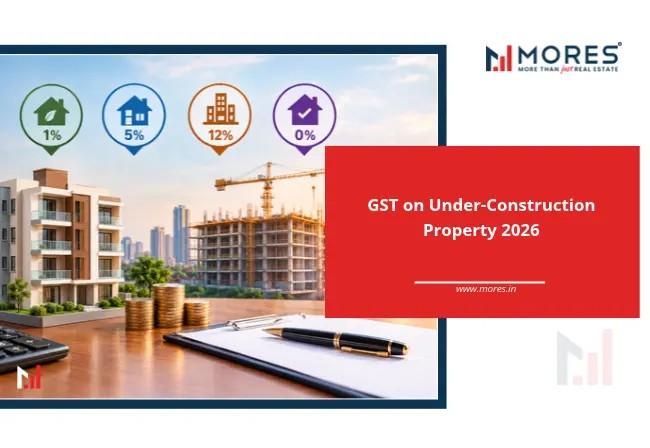
GST on under-construction property in 2026 is charged at 1% for affordable housing (units up to ₹45 lakh and 60/90 sqm) and 5% for non-affordable flats (without ITC). Ready-to-move-in homes with an Occupancy Certificate carry 0% GST.
For people interested in making deals with property in India, it is vital to know something about statutory indirect taxes. If you are a potential house purchaser or a property investor, GST on under-construction property in 2026 will be a key factor to consider. In any case, a system of taxation approved by the Goods and Services Tax Council defines the way residential and commercial properties are to be taxed depending on the construction stage, the evaluation of property, and its dimensions.
If you are planning to book an apartment in a skyscraper building or just buy an affordable house, knowing the basics of GST on under-construction property in 2026 allows you to estimate the total cost of purchase. The following guide provides you with information about tax brackets, eligibility criteria, and GST calculation.
1. Statutory Tax Rates for ready-to-move Properties in 2026
The applicable tax rate for acquiring any property largely depends on whether the unit is residential or commercial and on its completion status. In evaluating the GST on under-construction property 2026, the law has categorized the residential real estate into two major GST rates without Input Tax Credit (ITC):
- Affordable Housing Units: GST at the rate of 1% without ITC.
- Non-Affordable (Standard) Residential Units: GST at the rate of 5% without ITC.
- Commercial Units: GST at the rate of 12% with ITC benefits.
- Completed Units with Completion Certificate (CC): GST at 0% (Exempt).
In the case of CGST and SGST Act, the land value is considered to be one-third (33.33%) of the total property agreement value. This is why the headline rates of 1.5% (for affordable) and 7.5% (for standard residential) have been adjusted by a one-third land abatement, leading to effective tax rates of 1% and 5%, respectively.
It is very important for all property buyers to evaluate the official GST rate on flat purchases in India before making any booking payments.
2. Qualifying Criteria for GST on Affordable Housing Property
For the concessional 1% slab of tax under GST on affordable housing property, a residential flat needs to comply with two statutory conditions defined under the GST regime simultaneously.
Condition A: Gross Agreement Value
The gross price or total agreement value of the residential flat cannot be more than ₹45 Lakhs. This upper limit includes the basic cost of the property along with the compulsory developer’s charges, including preferential location charges, parking space allocation, and infrastructure charges.
Condition B: Carpet Area Ceiling
The maximum permitted carpet area is contingent on the municipality where the housing project is located:
- Metropolitan Areas: Not more than 60 square metres (about 645.83 square feet). Metropolitan areas include the municipal corporations of Bengaluru, Chennai, Delhi-NCR (Noida, Greater Noida, Gurugram, Ghaziabad, and Faridabad), Hyderabad, Kolkata, and the Mumbai Metropolitan Region (MMR).
- Non-Metropolitan Areas: Not more than 90 square metres (about 968.75 square feet) in any other city, town or semi-urban area in India.
If the value of the flat exceeds ₹45 Lakh even when the carpet area is below 60 square metres, the flat becomes non-affordable. In this case, the buyer will have to pay the standard tax rate under GST on under-construction property 2026.
3. How to Calculate GST on an Under-Construction Unit
Calculating the tax burden on a property booking is straightforward once the classification is established. The effective tax percentage applies directly to the gross agreement value. Here are two practical calculation scenarios illustrating GST on under-construction property 2026.
Scenario 1: Buying an Affordable Residential Flat
Consider a buyer purchasing a 2-BHK apartment in Pune with a carpet area of 75 square metres and a total agreement value of ₹40,00,000.
- Property Value: ₹40,00,000
- Classification: Affordable Housing (Value under ₹45 Lakhs and carpet area under 90 sq. m.)
- Applicable Tax Rate: 1%
{GST Amount} = ₹40,00,000 \times 1\% = ₹40,000$$
The net property cost prior to state stamp duty and registration fees comes to ₹40,40,000.
Scenario 2: Buying a Standard Residential Flat
Consider a homebuyer purchasing a 3-BHK flat in Gurugram with a carpet area of 110 square metres and a total agreement value of ₹80,00,000.
- Property Value: ₹80,00,000
- Classification: Non-Affordable / Standard Residential
- Applicable Tax Rate: 5%
{GST Amount} = ₹80,00,000 \times 5\% = ₹4,00,000$$
The total base outflow before local statutory charges equals ₹84,00,000, reflecting the applicable standard rate for GST on under-construction property 2026.
4. Under Construction vs. Ready to Move GST Difference
One of the most crucial financial decisions that a buyer faces is that of under construction versus ready to move GST difference. Knowing about the distinction made by the law in this regard could help buyers save a lot of money.
Why Ready-to-Move Properties Bear Zero GST
As per Schedule III of the CGST Act, the sale of land and built-up structures is not considered as the supply of any goods or services. After a builder gets a Completion Certificate (CC) or Occupancy Certificate (OC) from the concerned local authority, the structure becomes an immovable property. Therefore, no tax is charged for ready-to-move flats with CC/OC or resale flats.
Key Financial Comparisons
Analyzing the financial impact of this distinction highlights the following key points:
- Tax Liability: Under-construction flats attract 1% or 5% tax depending on category, whereas ready-to-move-in flats attract 0% GST.
- Base Price Dynamics: Under-construction properties generally feature lower base prices per square foot compared to completed projects, offsetting part of the tax liability under GST on under-construction property 2026.
- Payment Structure: Buying an under-construction unit allows stage-wise payment schedules, meaning GST is paid incrementally on each construction milestone installment rather than in a single lump sum.
5. Input Tax Credit (ITC) Rules and Developer Pricing
In the current tax regime for residential housing, the developer is not eligible for the Input Tax Credit (ITC) on the inputs consumed during construction, which include items like steel, cement, architectural services, and contractor charges.
Since the developer cannot set off the input taxes paid to the suppliers against the tax charged to the buyer at either 1% or 5%, these uncredited input taxes become a part of the cost of construction of the project. While analyzing the GST on an under-construction property in 2026, the buyer should make sure that the developer charges only the effective tax rate (1% or 5%) on the agreement value.
6. Additional Developer Charges and Applicable Tax Rates
When buying a flat, developers frequently charge for ancillary services. Here is how indirect tax rules apply to these common additions under GST on under-construction property 2026:
- Preferential Location Charges (PLC): Fees charged for premium views or higher floors form part of the construction service and attract the same 1% or 5% rate as the residential unit.
- Car Parking Allocations: Covered parking space bundled with the flat agreement attracts the same effective tax rate (1% or 5%) as the primary apartment.
- Clubhouse and Infrastructure Fees: Charges for clubhouse membership and internal infrastructure development bundled into the sales contract carry the same residential property tax rate.
- Advance Maintenance Deposits: Collections taken for future maintenance or corpus funds deposited into dedicated association accounts follow separate service tax guidelines depending on the society's operational thresholds.
Conclusion
Understanding GST on under-construction property in 2026 enables buyers to plan their home purchases with complete financial clarity. By knowing the GST rate on flat purchase India, verifying eligibility for GST on affordable housing property, and evaluating the under-construction vs ready-to-move GST difference, you can optimize your property budget and ensure accurate tax payments across every transaction stage.
Frequently Asked Questions (FAQs)
Q1. Is GST payable on the entire agreement value including land?
Yes, but the law accounts for land value by applying a mandatory one-third (33.33%) land abatement. The headline rates of 1.5% and 7.5% are reduced to effective rates of 1% and 5%, respectively, when computing GST on under-construction property in 2026.
Q2. Does GST apply to resale flats or open land plots?
No. Resale flats sold by individual owners and plots of undeveloped land are transfers of immovable assets and remain completely exempt from GST.
Q3. What is the standard GST rate on flat purchases in India for commercial spaces?
Under-construction commercial properties attract a 12% effective GST rate with Input Tax Credit benefits available to the developer or buyer (if registered).
Recent Blogs
Get Expert Property Advice



Assistant


