

Over Time, Has PG Investment in India Increased or Decreased, and Why?
Oct 30, 2026
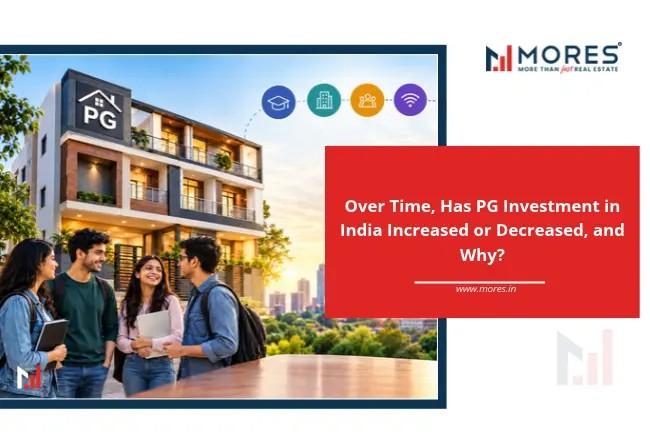
Over the past two decades, there have been immense changes in the Indian real estate scenario. Among residential investment categories, PG accommodation and co-living are lucrative investment avenues. Investors who prefer steady cash flow and higher rental yields than apartments can explore the world of PG accommodation in India.
But the obvious question that comes to mind for all investors and real estate enthusiasts is: Does the investment in PG accommodation increase or decrease over time, and why?
To understand the trend in this market, it is necessary to examine demographic trends, urbanization, yield trends, and changes in the real estate environment. The simple answer is that, despite any disturbance, such as the pandemic situation of COVID-19, PG investment in India has increased exponentially over time.
Historical Context: The Shift Toward an Organized PG Business
In the past, PG services were mostly run on an unorganized level. Individuals with available rooms or vacant floors would rent beds to students and young professionals. While this would earn them some extra cash, it was never considered to be an investment avenue.
In the last 15 to 20 years, the IT boom, the growth of multinational companies, and the rise of private educational institutions have transformed the face of the city. There has been a large-scale movement of the youth to tier-1 and tier-2 cities such as Bengaluru, Pune, Hyderabad, Gurgaon, Kota, and Noida.
With the increased migration, the conventional mode of renting homes – which involved huge security deposits, lengthy lock-ins, and extensive unfurnished arrangements – turned out to be unsuitable for young professionals and students. Realizing this need, astute property owners and developers started buying or modifying their entire property to run a PG business.
Key Drivers Behind the Growth of PG Investment in India
The move toward greater investment in PG in India is made possible by solid economics, changes in population structure, and changes in tenants' tastes and preferences. There are a few reasons as to why there has been a continuous inflow of capital for PG investment in India.
Maximizing Yields and Unlocking Superior PG Rental Income
There is one key factor that explains the continued rise of PG investment in India – the yield rate. The normal yield rate in India on a rented single-family property is somewhere in the range of 2% to 4%. However, well-maintained PG rents can provide the investor with gross yields of 7% to 12% (sometimes even more in the case of education or technology clusters).
Rental of the property per bed is always more efficient than per apartment. The higher yield means a shorter payback period for the investor.
Capitalizing on the Continuous Surge in PG Demand in India
The core reason behind high rental returns lies in the increasing demand for PGs in India. In various demographic studies, it has been noted that India boasts one of the youngest populations across the globe, with millions of people pursuing higher education and joining the corporate world each year.
With the growth of educational centers and tech corridors, the need for temporary accommodation rises rapidly. Young students and the workforce prefer convenient living arrangements close to universities and offices, with features such as Wi-Fi, laundry services, and food. This consistent flow helps in maintaining the PG demand in India.
Institutionalization and Scaling the PG Business Model
A third important factor behind the rise in PG investments in India is the emergence of organized co-living ventures and asset management companies (including Stanza Living, Zolo Stays, and many more). Earlier, investors were reluctant to expand their portfolio of PGs because of the challenges associated with managing the property – tenant management, security, maintenance, and rent payments.
Nowadays, investors can buy or lease a residential building and manage the operations through an organized co-living firm on a long-term rental or revenue-sharing contract. The change has turned the PG business from being an active, hassle-filled business to a passive income-generating activity, attracting risk-averse and retail investors to the segment.
Market Resilience: Overcoming Pandemic Disruption in PG Investment in India
There is no way one can ignore the effects of the COVID-19 pandemic of 2020-2021 when looking at trends in investment in the PG sector. Due to university lockdowns and mandatory work-from-home policies adopted by corporations, millions of migrant workers came back to their home villages. The occupancy rate fell sharply, causing unorganized firms to wind up, leaving many speculating about a permanent decline in PG investment in India.
Post-2022, however, with the adoption of hybrid models in offices and the opening of universities in the country, there was a record housing crunch. The bounce-back of demand witnessed more strength than before. Migrant workers seeking to return to their respective metropolitan cities desired managed housing that offered good sanitation and privacy. Therefore, investment in Indian PGs picked up at a fast pace.
Strategic Advantages Driving Continued Growth
The main strengths that come naturally to investors in Paying Guest properties include:
Risk Reduction via Spread of Tenancy: As a typical residential tenancy ends with just one tenant leaving, there would automatically be a 100% drop in rental revenues. With a multi-bed unit, this risk can be spread across all occupants in that property. A mere change of 2 tenants within 10 will only reduce revenue by 20%.
Cash Flows Adjusted for Inflation: Unlike commercial rentals, where rent increases may be fixed over the course of 3 to 5 years, rents of PG rooms can increase annually or even biannually based on demand and inflation rates.
Optimal Utilization of Space: The best part about investing in micro-living units is the optimal utilization of space.
Challenges in Managing the Growing PG Demand in India
While the trajectory of PG investment in India is overwhelmingly positive, modern investors must navigate specific operational and market challenges to ensure success:
- Higher Capital Expenditure: Establishment of a modern facility involves considerable initial investment in the form of fittings, air conditioning, security systems, kitchen appliances, and electricity backup.
- Operational Intensity: Independent operation of a PG business demands constant focus on hygiene, food quality, maintenance, and compliance with regulations (such as police verification of tenants and fire safety regulations).
- Location Dependency: The success of the PG model depends a lot on its location. Even a property located two kilometers away from a major tech park or educational institution can witness much lower PG demand in India than one that is closer by.
Future Outlook: The Evolution of PG Investment in India
In terms of future prospects, there is no stopping the trend of PG investments in India. With urban real estate becoming more and more expensive, it is difficult for young people to buy full-fledged apartments, and this leaves renting as the only option.
Moreover, tier-2 cities such as Jaipur, Ahmedabad, Indore, and Coimbatore are fast becoming economic centers. The growing PG demand in India is thus spreading from tier-1 cities to tier-2 cities, with corporations setting up their satellite offices and universities expanding their campuses.
For investors who concentrate on offering good amenities, strong security measures, fast internet, and good management, there is a lot to gain from investing in PGs.
Conclusion
In the following years, PG investment in India has undeniably risen both in terms of size and sophistication. From being just a makeshift form of earning income out of unused space to becoming a profitable and resilient sector in the Indian real estate market, PG investments have definitely proven their worth through demographic strengths, higher returns on investments, and efficient management solutions.
Recent Blogs
Get Expert Property Advice



Assistant


