

How Cities Boost Quality of Life In Real Estate
Oct 27, 2026
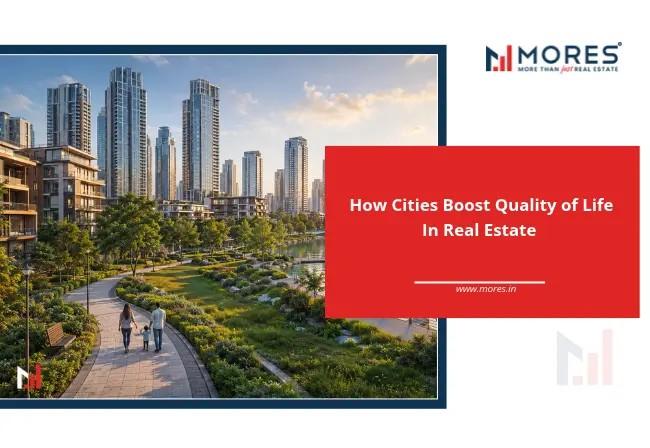
People who assess a piece of property always take into account aspects such as price, location, and connectivity, but there is one aspect that has become increasingly crucial in recent years – quality of life. Quality of life in relation to real estate becomes evident in cities where people can work, study, receive medical care, move around, and enjoy leisure activities.
What Does Quality of Life Mean in a City?
The quality of life is not about having pretty houses and modern buildings. Rather, it is the comfort level at which people can live, work, commute, and have access to necessary facilities. Such elements include efficient public transportation, educational institutions, hospitals, job options, green spaces, shopping centers, cleanliness, and recreational facilities. Quality of Life in Real Estate: This Knowledge Helps Buyers Make Informed Choices About Locations.
How Quality of Life Influences Real Estate Demand
The relationship of quality of life in real estate can be understood better by looking at the reasons for choosing certain locations. A house is more than a building; it is about the environment that surrounds it.
A family may want to live in an area where there are schools, hospitals, parks, and shopping centers. A professional may choose a location that has good employment opportunities and transportation systems. A retiree may go for health care, a peaceful environment, open spaces, and amenities.
In search of suitable locations according to one’s lifestyle, residential demand can emerge in certain existing areas. Such demand will help achieve occupancy, leasing, and buying activities; however, the performance of properties depends upon other factors too.
Quality of life in real estate can influence rental demands as well in existing urban areas.
Why the Best Cities to Live in India Attract Real Estate Interest
The best places to live in India include jobs, infrastructure, education, health, connectivity, culture, and lifestyle. What qualifies a city to be the “best place” depends on each individual, although the above factors might affect property needs.
Economically diversified cities will tend to draw employees from all corners of the nation. The influx of people means that housing needs will increase and will lead to demand for flats, individual houses, rentals, etc. Infrastructure developments can create more areas for residential properties.
It shows the strong link between the standard of living and real estate. As a city becomes more convenient to live in, its residential areas might gain popularity among buyers and tenants.
Infrastructure and Connectivity Can Add Property Value
Connectivity is probably the most powerful factor connecting quality of life with real estate. Locations that are well-connected to the highways, metro stations, airports, railway networks and employment hubs can serve as attractive residential destinations.
Thus, for potential buyers, an evaluation of the quality of a particular property should not be limited to the analysis of its amenities. It might be beneficial to consider the ease of access for residents to their workplace, schools, hospitals, shopping places, and public transportation.
Social Infrastructure Makes Neighbourhoods More Liveable
Apart from a sufficient housing supply, a good quality residential location should have some other factors. Social infrastructure might help residents have easy access to such amenities as schools, colleges, hospitals, shopping malls, supermarkets, restaurants, parks, fitness centres, etc.
This is another factor that connects quality of life with real estate. When the residents have access to their basic needs, a certain location might become more attractive for both buyers and tenants.
When people are looking for the best cities in India, they should also consider evaluating individual neighbourhoods instead of evaluating a whole city. Two areas in the same city can differ a lot in their connectivity, infrastructure, housing supply, and liveability.
Employment Hubs and Residential Demand
Workforce possibilities are yet another important element that links quality of life with real estate. The cities having good IT sector, industrial sector, financial sector, educational facilities, healthcare sector, government, and many others will be able to attract a considerable number of workers. This workforce will require residences near workplaces or transport networks.
The more a city develops in terms of being an employment centre, the more its residential regions might face demand for apartments and rented accommodations.
Green Spaces and Recreation Matter Too
However, quality of life is not decided only on the basis of economics. The availability of parks, green spaces, walkways, sports arenas, cultural sites, and recreational sites can affect people’s perception of the neighbourhood.
The residential development near open spaces, recreational sites, or social infrastructure might provide a different quality of life compared to the densely developed region with scarce infrastructure.
Hence, while analysing quality of life in real estate, the buyers must keep in mind the infrastructure and lifestyle elements.
Buyers who value open spaces and well-planned neighbourhoods can also explore property in Noida, where several residential sectors offer a mix of green areas, wide roads and social infrastructure.
How to Compare Cities Before Buying Property
There is no single answer to which city qualifies as India’s best city for every homebuyer. Requirements differ depending on income, profession, family size, lifestyle, and long-term plans.
Instead of relying only on rankings or general perceptions, prospective buyers can compare cities using practical parameters such as employment opportunities, connectivity, education, healthcare, housing affordability, environmental conditions, lifestyle options, civic infrastructure, and future development.
- Someone working in tech may prioritise a major employment hub, while a family may focus more on schools and healthcare. These different priorities show why city comparisons should be personalised.
- For buyers exploring the best cities to live in India, local infrastructure matters as much as citywide reputation.
- Those comparing the best cities in India can examine employment, transport, healthcare, and housing together.
- Among discussions about the best cities in India, liveability is an important practical consideration.
The phrase India’s best city can mean different things depending on a buyer’s lifestyle and financial priorities.
Rather than selecting India’s best city from a single ranking, buyers can compare measurable local factors.
How Quality of Life Can Support Long-Term Property Demand
The value of real estate is affected by various variables such as location, supply and demand, infrastructure, economy, quality of project, and cycles of market. Quality of life is just one component of all these elements.
Where the presence of jobs, infrastructure, education, healthcare, and quality of life attracts residents to a particular city, it could keep the demand for its housing intact. In the city, areas that provide easy access to all such amenities become significant in the eyes of buyers.
Thus, the quality of life in real estate must be evaluated together with assessing the residential property market. However, quality of life should never be taken as the sole determinant of rising property prices. There are many more factors that must be looked at by buyers while purchasing a property.
Quality of Life Is Becoming an Important Real Estate Consideration
The connection between the quality of life in real estate is indicative of the new attitude towards the choice of a home. Home buyers are more inclined to pay attention not only to the property itself but to the overall experience of living in a certain place.
Among the best cities to live in India, you can find some places that have great employment opportunities, connectivity, social infrastructure, healthcare facilities, educational options, entertainment and sports activities, and affordable housing. However, the choice of the right city and the best area will always depend on the priorities of each buyer.
Those who want to choose the best city for investment in real estate in India should take into consideration the issue of the quality of life. In addition to price questions, they should pay attention to the ease of access to work, healthcare, education, transport facilities, recreation, and other everyday needs.
Also Read: Flats Under ₹1 Cr in Greater Noida West
Recent Blogs
Get Expert Property Advice



Assistant


