

India Steps Up Land Digitisation with New DILRMP 3.0 Framework
Sep 12, 2026
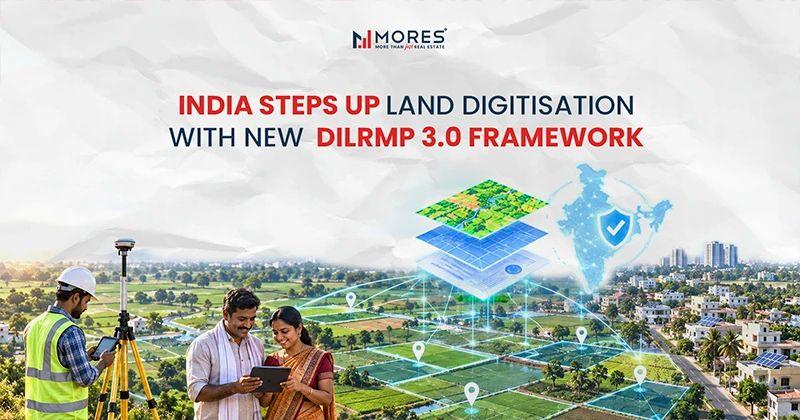
12 September, NEW DELHI —The Union Minister of Rural Development, Shivraj Singh Chouhan, has launched the guidelines for implementation of Phase III of the Digital India Land Records Modernization Programme (DILRMP 3.0). DILRMP 3.0 has been approved as a 100% Centrally Sponsored Scheme of Central Sector under the name of “Digital Land Stack – Land Records Modernisation” with an outlay of ₹565.50 crore for a five-year period from 2026 to 2031.
In his speech at the launch function at Krishi Bhawan, the Union Minister said that DILRMP 3.0 takes land digitization in India to the next level by moving from standalone computerisation of revenue systems towards the integration and GIS-based Digital Land Stack. The main objective of this scheme would be to develop a seamless ecosystem with land record management, spatial mapping, property registration data, and revenue courts all working seamlessly.
Core Framework and Key Objectives
The DILRMP 3.0 guidelines outline six structural pillars designed to modernize real estate and land administration:
Federated National Land Stack: Each individual state and union territory is supposed to build state land stacks using its available records, and such localized systems are supposed to interface with each other through protocol layers to build a federated National Land Stack that enables interoperability between systems but also gives sovereignty to states over their land records.
Universal Bhu-Aadhaar (ULPIN): Each piece of surveyed land in India will be provided with an alphanumeric Unique Land Parcel Identification Number (ULPIN), popularly referred to as Bhu-Aadhaar, which is made up of 14 digits. Such identification codes are to be pinned onto georeferenced cadastral maps for the purpose of avoiding duplicity of land titles.
Registration Seva Kendras: With a dedicated component allocation of ₹37.5 crore, 75 high-footfall Sub-Registrar Offices (SROs) will be transformed into modern "Registration Seva Kendras." Modeled after the Passport Seva Kendras, these centers will offer biometric verification, single-window processing, and automated document generation to minimize public waiting times.
Paperless Registration and Archiving: The scheme proposes an end-to-end online registration of properties with the support of the Registration Repository. Old land records and registers will be digitized and archived to have a tamper-proof history of titles.
Revenue Court Case Management Linkage: The Revenue Court Case Management System (RCCMS) for all the districts will be digitized and integrated with the land registry. Legal issues, if any, on the property will automatically appear as an encumbrance on the RoR of that property.
Urban Land Survey and Mapping (NAKSHA): With the lessons learned from the NAKSHA project, the scheme proposes scaling up urban land surveying and issuance of digital property cards in the municipal area.
Track Record and Expected Impact
This third iteration builds on the strong foundation laid by the original Digital India land records modernisation programme. Prior phases successfully achieved:
- 99.9% computerisation of Records of Rights (RoRs) across villages
- 97.0% digitisation and georeferencing of legacy cadastral maps
- 99.0% computerisation of Sub-Registrar Offices nationwide
Release of this ₹565.50 crore would be in a performance-based tranche process, monitored through a real-time DILRMP MIS dashboard. The Ministry is hopeful that DILRMP 3.0 will reduce the cost of litigation, make it easy for banks to verify their collateral in terms of loans for agriculture and houses, and will not require citizens to visit the local revenue offices again and again.


Assistant


