

Real Estate Terms in India- The Ultimate Guide for Every Homebuyer and Investor
Jun 6, 2026
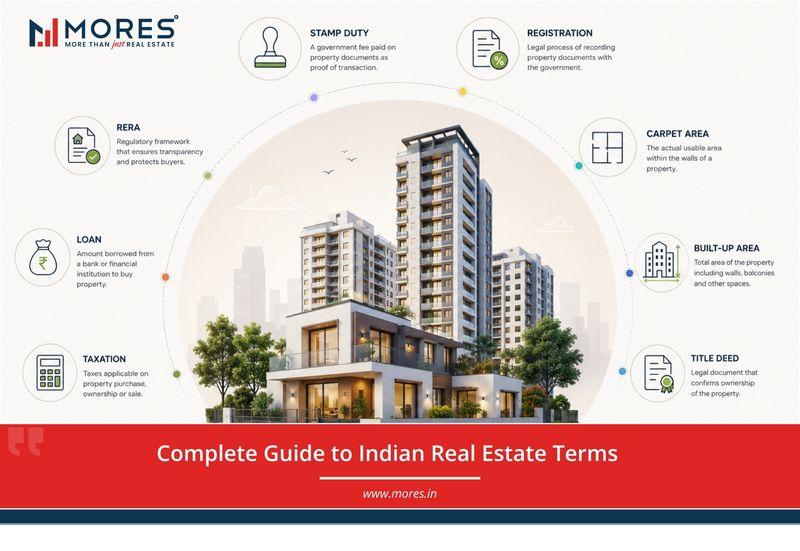
Real Estate Terms in India are crucial for anyone who wishes to purchase, sell, or invest in real estate. From the legal documents to financing details, to ownership rights and even government approvals, these terms have an impact on the entire real estate or property transaction. With the real estate market still on the rise in India, buyers are keen to have access to reliable real estate information in order to make informed choices and steer clear of shady investments. Real estate is one of the key industries in the Indian economy.
India has come a long way in the real estate sector (also referred to as the property market) and is one of the top wealth creators in the country. Despite such price movements, the data from industry sources shows that the total transaction value of residential has crossed ₹4.46 lakh crore in 2025 and the total sales which were transacted have crossed 5.45 lakh units in total in the 13 major cities.
As investors and first-time buyers are already acquainted with these terms, end users who haven't invested in any property before should know about these important Property terms in India to avoid any legal hassles and financial errors in the project. The terms are not just very significant, but also mean a lot during the process of the actual purchase of a property, spanning from the rights of ownership, financing and taxation to approval. Understand the terms used to describe the size and measurement of properties.
Understanding Property Size and Measurement Terms
One of the most searched Property terms in India for buyers is these measurements, which directly influence pricing and usability.
- Carpet Area- Carpet area is the actual space inside the property or an apartment, which is usable and on which you can actually lay a carpet.
- Built-Up Area- This area includes the thickness of the wall and balconies
- Super Built-Up Area includes a share of common areas like the lift, staircases, clubhouse, lobby, etc.
The Carpet Area is clearly stated by the developers under the regulations of RERA (Real Estate Regulatory Authority) to make it more transparent.
Types of Properties Available in the Indian Market
- Under Construction- An Under-Construction Property is likely to sell for less and have a flexible payment arrangement, but may come with construction and delivery risks
- Ready to move Property- In a Ready-to-Move Property, you can immediately move in, avoiding project delays.
- Resale Property- A resale property is one which has been sold by someone else and is expected to have infrastructure, occupancy and social amenities in place.
These are some of the most essential Real Estate Terms in India, which people must know before buying a house.
Home Loan and Financing Terms Every Buyer Should Understand
Finance is one of the most crucial factors in real estate, and it is crucial to understand these real estate finance terms before applying for a home loan.
- Loan-to-Value Ratio (LTV)- This is the ratio of the amount of loan and the value of the property. According to the RBI guidelines, the lender can give a loan to the buyer for 90% of the property value in some categories, which will ease the burden on the buyer.
- Home Loan EMI- A Home Loan EMI is the monthly payment which is made on the source of the loan.
- The mortgage loan is a loan of real estate that is used to purchase real estate.
Legal Documents every buyer must verify
While buying a property, it is important to have proper knowledge of the following legal documents and real estate terms to make an informed and secure investment decision.
- Sale Deed- A legal instrument that officially transfers ownership of real estate from the seller to the purchaser when it is sold.
- Title Deed- A document used to prove ownership and give the legally recognised right to the property owner.
- Agreement to Sell- An initial agreement that specifies the terms and conditions agreed to by the buyer and seller before the transfer of the property.
- Property Registry- This is the official government document that registers property transactions, thus enabling their legal validity and enforceability.
- Allotment Letter- Letter from the developer that constitutes the allotment of a particular property unit to the purchaser.
- Possession Letter- This is a formal letter from the developer to convey to the buyer that the property is ready to be taken possession of and handed over.
- Power of Attorney (POA)- A legal authorisation document giving permission to a designated individual to act and make decisions on behalf of the property owner.
- Developer-Buyer Agreement- It is a contract which outlines the rights, obligations, payment terms, project timelines, penalties and responsibilities of the developer and buyer.
Government Approvals and Compliance Requirements
- Completion Certificate (CC)- Certificate issued by the competent authority verifying that the project has been completed as per the approved building plans and relevant development regulation.
- Occupancy Certificate (OC)- A certificate of safety for the building and its compliance with all legal and regulatory requirements.
- No Objection Certificate (NOC)- The approval received from the relevant authorities that they have no objection to the registration or transfer of the property or the financing or development of the property.
- RERA, or Real Estate Regulatory Authority- A regulatory body set up to increase openness, responsibility and effectiveness inside the real estate market, making sure that homebuyers are safeguarded.
- Encumbrance Certificate- A legal document which is used to declare that a property is free from monetary obligation, mortgages, legal issues or any other encumbrances for a particular duration.
- Mutation of Property- The process by which local government land records are updated when the ownership of a piece of land is transferred or inherited.
- Circle Rate- This is the lowest monetary worth of the property, as determined by the State Government for calculating stamp duty and registration charges.
- Floor Area Ratio (FAR)- The ratio of the total floor area (built up) of a building to the area of the site that it occupies, determining the limits of construction.
Project Delivery and Possession-Related Terms
- Possession Date- Date at which the buyer shall expect to receive the property from the developer in a physical form.
- Completion Timeline- The estimated timeframe for a real estate project to be completed and ready for occupancy.
- Pre-Launch Project- A property project that is introduced to buyers before receiving all necessary regulatory approvals, often at a lower price point to attract early investors.
- Soft Launch Property- These are the properties that are being offered to a small number of buyers or investors before their official public launch.
- Capital Appreciation Potential- The potential of the property's value falling over time so that the investor can benefit from an increase in the value of their investment.
- Importance of Due Diligence- Pre-launch and soft-launch properties might be good investment opportunities, but investors should confirm approvals, legal clearances, developer credentials and project timelines before investing.
Investment Metrics Every Investor Must Understand
- Appreciation Value- The rise in the market value of a property over a period of time, based on the events that took place in the surrounding area, infrastructure and market demand.
- Capital Appreciation- An increase in the value of a real estate investment over a given period of time that can lead to wealth building for the investor.
- Rental Yield- An annual rental income percentage of property market value that is used to measure investment returns.
- Occupancy Rate- The percentage of units in a property or project that are in use at a specific time; level of utilisation or demand.
- Real Estate Investment Trust (REIT)- A type of investment company that enables individuals to invest in income-producing real estate assets without owning or managing properties.
- Benefits of REITs- REITs give investors the chance to invest in large-scale commercial real estate projects, regular income opportunities, portfolio diversification and increased liquidity versus owning a property directly.
- Growing Popularity of REITs in India- As the asset base of listed REITs has increased and they now make regular payouts to shareholders, they are becoming a popular choice for investors looking for exposure to the real estate sector.
Additional Costs Associated With Property Ownership
- Stamp Duty- Government tax levied on the transfer of property, based on its value, and paid when the property is officially registered.
- Registration Charges- These are the charges that are paid to the government for the property to be officially recorded in public records as a property transaction and for the property to be transferred to the new owner.
- Property Tax- A tax on property that is paid yearly by property owners to local municipal governments for civic services and infrastructure.
- Preferential Location Charges (PLC)- An additional charge which is levied on properties that have special amenities like a park-facing view, corner location, higher floor or better accessibility in a project.
- External Development Charges (EDC)- Charges levied on development projects to pay for the external infrastructure that is not directly connected to the project itself, but is necessary for the development of the project.
- Internal Development Charges (IDC)- Charges for the development and upkeep of infrastructure within the project, such as internal roads, parks, lighting and common facilities.
- Maintenance Charges- These are the recurring charges to be paid by the property owners for services like security, housekeeping, landscaping, facility upkeep and management and common areas upkeep.
- Corpus Fund- A fund that is raised by the property owners to cover future operational and long-term maintenance costs of the property or community.
- Sinking Fund- A separate fund that is set up to pay for large expenditures in the future, such as structural repairs, equipment replacement, renovation projects and capital improvements.
Special Ownership and Legal Considerations
Joint Venture Property & Benami Property: Joint Venture Property is a joint development between a landowner and a developer, whereby both share the risks and the rewards. The concept of a Benami Property is one where the name of the property is in one person's name, and the payments are made by another person. Indian law places significant restrictions on these types of arrangements and could have devastating consequences if it is found to be non-compliant. Gaining an understanding of the real estate terminology in India is more important than ever before.
Conclusion
Understanding real estate jargon in India is among the key elements of being a successful real estate owner and investor. There are many terms that can impact your finances and legal matters, from an under-construction property to calculating an EMI or checking a property's Sale Deed, Developer Buyer Agreement or checking a Real Estate Investment Trust (REIT); every term can make a difference.
The real estate industry in India is constantly changing, with technology, new regulations, and institutional investment playing a crucial role in its continued growth. In the ever-evolving real estate sector in India, buyers need to understand the key Property terms in India. Knowing these basic Real Estate Terms in India can help prospective home buyers reduce risks, make wise choices and build wealth in the long run by making intelligent investments in real estate.
Recent Blogs
Get Expert Property Advice



Assistant


